


Modes for Guitar – Part 4 – The Diminished Mode
The final mode, and the one that you’re very unlikely to lean on too often is the Locrian Mode. The reason this mode is not used as a main sound for a lead line is because it has a very diminished sound. This is a tricky sound to use for an entire solo.
It does have it’s uses as a single lick scale that you can take a run from, but you’d probably find it tricky to jam for 10 minutes with this.
We’re going to link these to the 1st shape of the Minor Pentatonic scale, but you could also link this to the Phrygian mode that you learn in Part 2 of this series and add a b5 note.
The Pentatonic shape you’ll be using is this one:
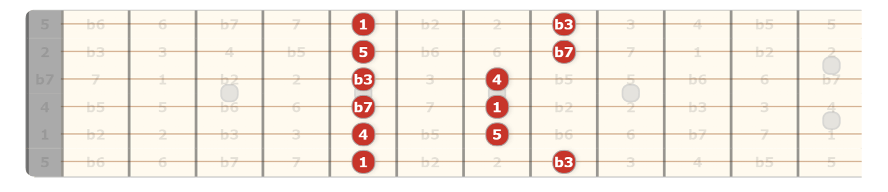
| I | bIII | IV | V | bVII |
| A | C | D | E | G |
This mode is shown in A Minor but it can be transposed to any other key.
Locrian Mode
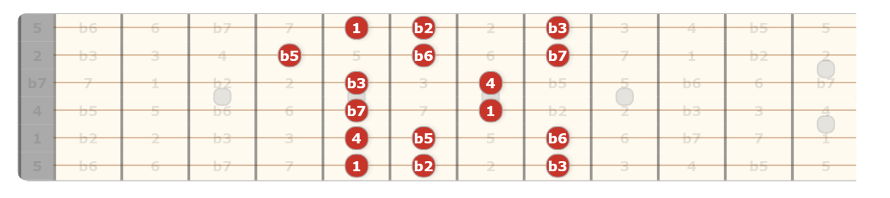
| I | bII | bIII | IV | bV | bVI | bVII |
| A | Bb | C | D | D# | F | G |
As you can see from the fretboard diagram, the finger pattern for this scale looks a little like the Phrygian mode, but the 5th notes are all flattened a semi tone to become a b5. This is the note that gives the scale its overall diminished sound.
This is a note you don’t want to lean on too much, especially over the root of the track you’re playing it with.
My personal approach to this mode is to use it for passing notes when I’m paying Phrygian or any other Minor leaning mode or pentatonic, rather than using it as a standalone scale.
Check out the video linked to this lesson to some tips on the Locrian Mode in practise.