


How to Write Minor Key Chord Progressions
Now that you’ve started to learn how to write songs using Major Chords from the Major scale, it’s time to flip things around to Minor. In this lesson you’re going to look at the Natural Minor scale and learn how you can use this scale to write chord progressions.
To start off, you’ll be referencing the A Major Scale. This scale is a gateway into understanding theory and also allows you to create other theoretical concepts. Here is the A Major Scale:

That is the first octave of the scale. We only need one octave for this. Now that we know the shape, we need to know the notes of the scale and give each one a number, known as an interval:
| I | II | III | IV | V | VI | VII |
| A | B | C# | D | E | F# | G# |
Using the A Major Scale, you can make a few amendments which will create a Minor Scale. This principle can be applied in any key.
To turn your major scale into a minor scale there are a few specific notes that need to be flattened. To flatten a note, you simply lower it’s pitch by a semitone.
The notes that need to be flattened are the 3rd, 6th and 7th degrees of the scale. This gives you a new note and interval structure compared to the A Major Scale.
| I | II | bIII | IV | V | bVI | bVII |
| A | B | C | D | E | F | G |
You’ll notice the C# becomes a C, the F# becomes an F and the G# becomes a G. This gives you A B C D E F G which are the notes of the A Natural Minor scale.
Once you know the notes, you can apply chords to each note. As with the Major, there is a set chord for each of the 7 degrees of the scale.
| I | II | bIII | IV | V | bVI | bVII |
| A | B | C | D | E | F | G |
| Minor | Diminished | Major | Minor | Minor | Major | Major |
Here are the chord diagrams for A Minor:
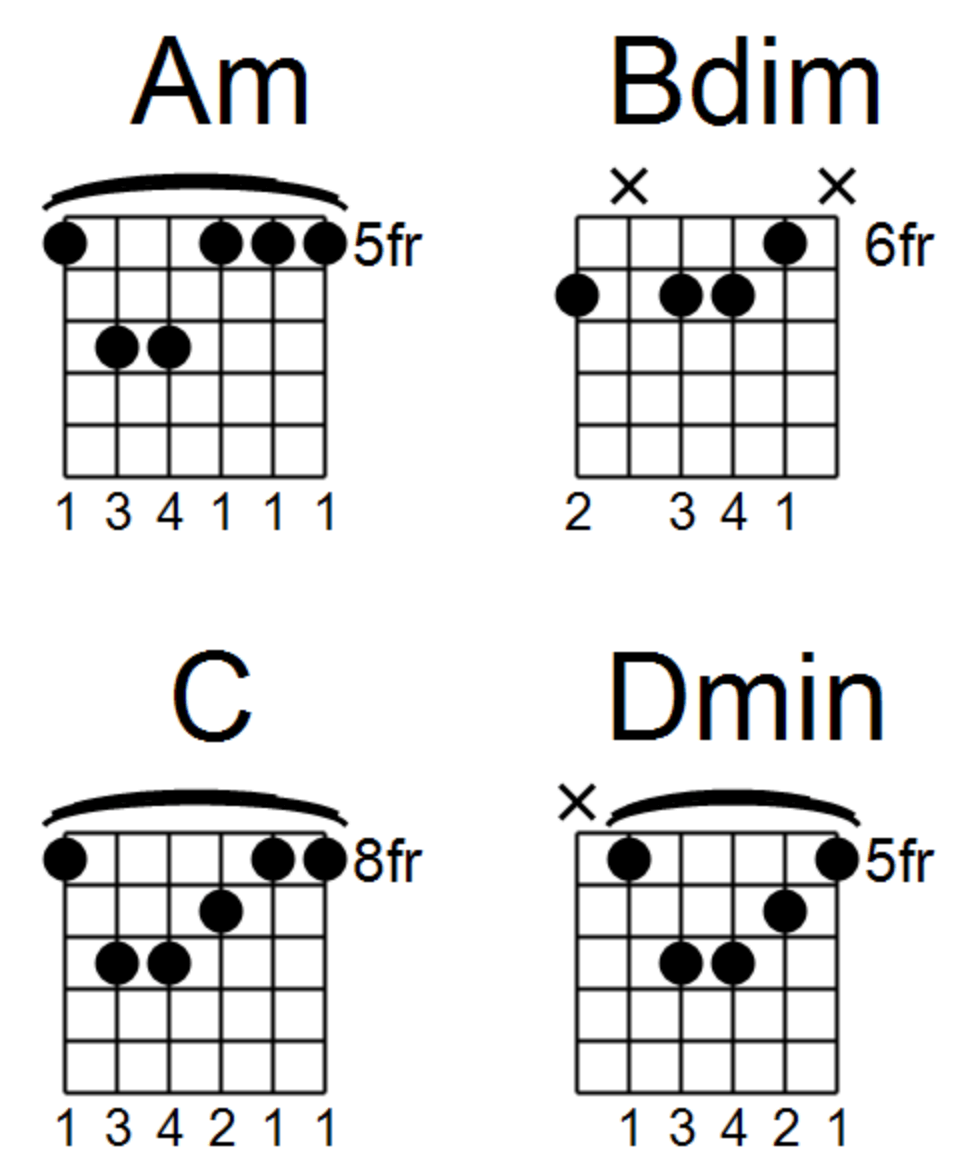

There are a few examples of minor key chord progressions in action in the attached video.
If you want to use this concept in another key, simply more the Minor Scale shape to a new root note, work out the notes and then apply the same chords to each interval of the new position, and now you can play chord progressions in any Minor key.
The same rules also apply for chord substitutions. You can switch any minor chord for a Min7 and any major chord for a Dominant 7 from the 10 Chords All Guitar Players Need to Know lesson on the Blackstar Youtube channel.