


Modes for Guitar – Part 2 – Minor Modes as Pentatonic Shapes
Now that you’ve started learning the Modes and you’ve gotten to grips with the Major Scale (The Ionian Mode) and the Natural Minor Scale (The Aeolian Mode), you can start to dig into other types of Modes.
In this lesson we will focus on the 3 Minor modes, the Aeolian mode is one of them and we will also use that as a springboard to discover the Dorian and Phrygian modes.
Rather than learning all the modes as a sequence of linked scales at this stage, we’re just going to learn them as single scale shapes that you can use as their own scale. We’re also going to tie them as close to the first position pentatonic shape as possible so you can use all your existing licks and add some modal flavours.
The Pentatonic shape you’ll be using is this one:
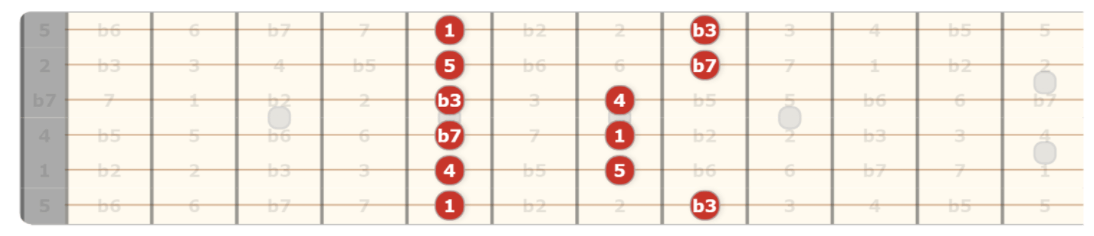
| I | bIII | IV | V | bVII |
| A | C | D | E | G |
All the scales here are shown in A Minor but they can be transposed to any key by moving the shapes.
The two additional modes we’re going to learn can both be seen as alterations of the Aeolian (Natural Minor) Mode. Let’s recap on that first of all:
Aeolian Mode
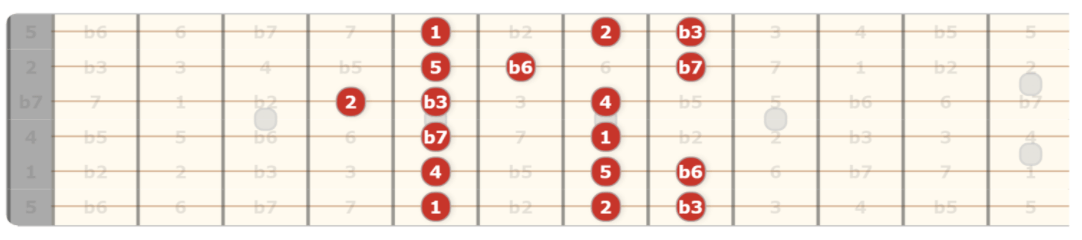
| I | II | bIII | IV | V | bVI | bVII |
| A | B | C | D | E | F | G |
This mode is the opposite tonality to the major scale, this is minor in its purest form. To pair this with pentatonic, you take your existing pentatonic shape and add the 2 and b6 intervals.
Dorian Mode
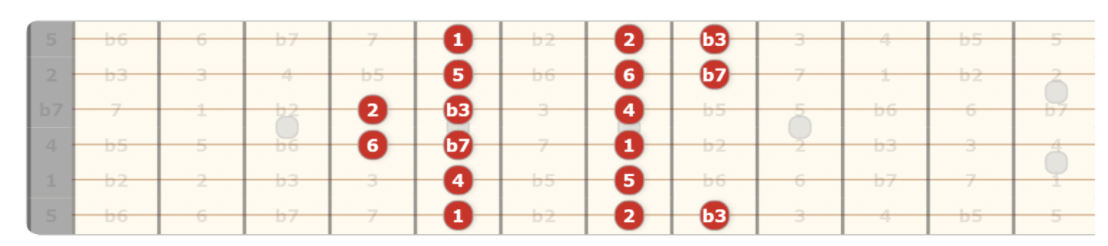
| I | II | bIII | IV | V | VI | bVII |
| A | B | C | D | E | F# | G |
The Dorian mode shares the same basic form as the Aeolian, except for the natural 6. In the Aeolian mode, the 6th is a b6, but here we’re raising that by a semitone. This gives the Dorian Mode a unique sound. The overall feel of the scale is minor, but the raised 6 gives a slight pull towards major. This is great over a blues progression made up of dom7 chords. The raised 6 makes licks feel like they’re in a major key, before shifting back to minor.
Phrygian Mode
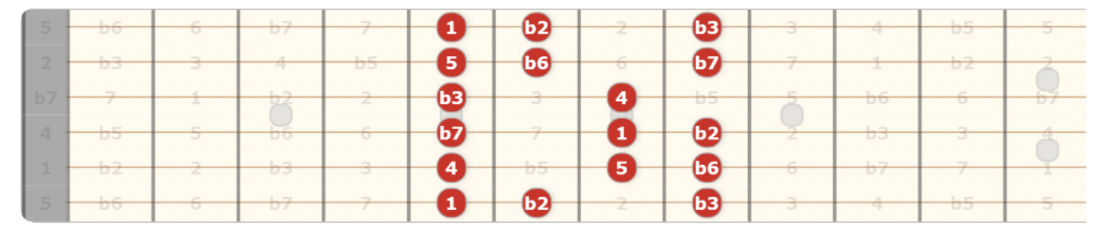
| I | bII | bIII | IV | V | bVI | bVII |
| A | Bb | C | D | E | F | G |
The Phrygian mode is commonly used in metal and rock, and it has a unique Eastern or Spanish flavour. This is provided by the b2 note. This shares the same notes as the Aeolian mode but the 2nd note is flattened by a semitone. This close movement from the 1 to the b2 is what gives this scale its identity.