How to Play the Minor Pentatonic Scale
If you’re just starting out and you’re wondering how all of your favourite guitar heroes are able to fly around the fretboard the way they do, then keep on reading.
The good news is, this isn’t some sort of magical secret. This is a simple pattern that you can follow.
Sure, many of your heroes are playing these patterns in their own unique ways, but getting started on the road to lead guitar success doesn’t have to be scary. In this lesson you’re going to learn a simple scale that will enable you to start out on this path.
This scale is called the Minor Pentatonic scale.
This is a 5 note scale that is repeated in octaves. Much like chords, scales also get a note based name associated based on where the root note (the lowest note) is positioned.
It’s essential to know the notes along your low E string so that you know where to position the scale for different keys. Here is a handle diagram of the notes on the Low E string:

Here is the shape of the Minor Pentatonic in A. As this is a 5 note scale, the only notes it contains are A, C, D, E and G.
The great thing with scales is that they are transposable, which means you can move the shape around to different keys just by changing the starting point. If you root that same shape from the 8th fret, which is a C, you get a C Minor Pentatonic:
If you root it from the 3rd fret, which is a G, you get a G Minor Pentatonic:

The Theory
If you want to dig a little deeper into the theory of scales, you first need to learn the Major scale. This is a scale from which all other scales, and theory concepts can be learnt. Here is the major scale in A.

If we assign a note and a number to each of the frets here, we get:
| 1 (I) | 2 (II) | 3 (III) | 4 (IV) | 5 (V) | 6 (VI) | 7 (VII) | 8 (I) |
| A | B | C# | D | E | F# | G# | A |
You may often see these written as Roman numerals. Notice that the 8th note is the same as the first, this is the octave of the pattern. This grouping of notes makes up the first octave of the A Major scale.
The numbers are known as intervals. Intervals are a measure of distance between notes but they can also be used as identifiers to pick out specific notes in scales.
To make a Minor Pentatonic scale, we need to take some notes from the A Major Scale and modify them.
The intervals of a Minor Pentatonic are 1, b3, 4, 5 and b7. The 1, 4 and 5 are all present but not the b3 and b7.
To work out the b3 you take the 3rd note from the Major Scale (C#) and flatten it a semitone to C. Do the same for the b7 by flattening the G# to a G.
This theory concept can be applied to any other key.
Practising the Scale
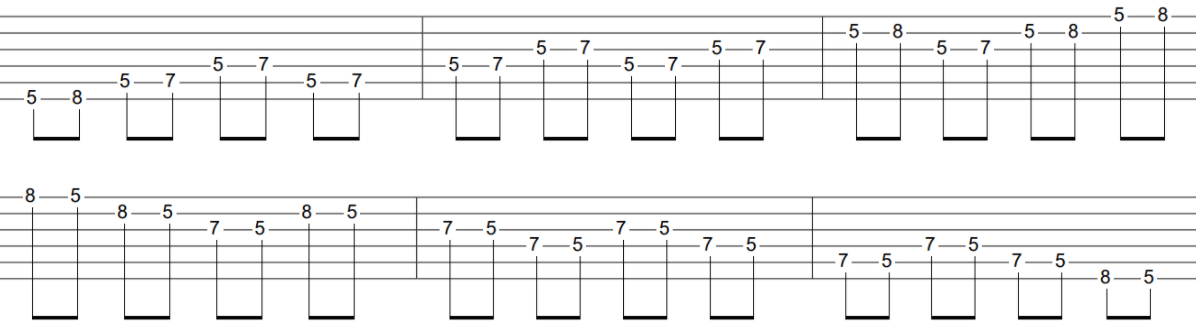
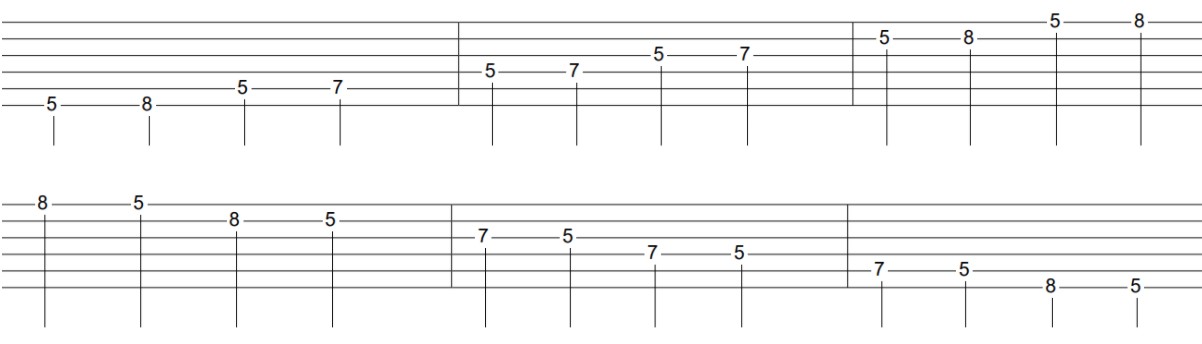
When practising scales, a great way to start is with a simple ascending and descending motion. Make sure you use alternate picking and get into that habit early on.
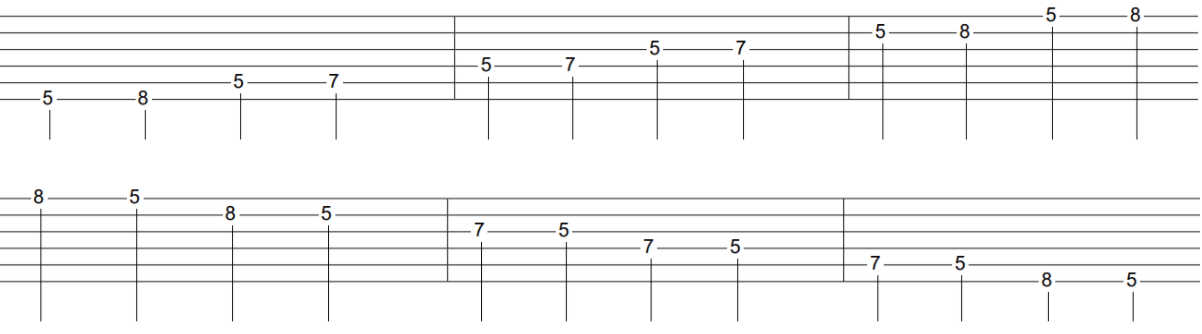
Once you’re comfortable with that and want to take it up a step, try this grouping. This will help your picking and fretting coordination and set you up for some “real world” playing later on. When you play scales in solos, you don’t often play them straight up and down in a linear fashion.
This exercise groups them in ascending and descending six note groups. Take your time and start slow.