How to Add Vibrato to Your Playing
Vibrato is one of the most expressive guitar techniques that a player can learn. It is a way to humanize your guitar playing and make notes and phrases take on a vocal quality.
Vibrato is a modulation of pitch. Front the notes starting point, the pitch is modulated up and back to the starting pitch over and over for the desired length of time.
Vibrato is unique to each player, many of your favourite guitar players will have their own Vibrato style which is one thing that makes them stand out from other players. As such, you will also develop your own style. Perhaps you’ll take elements from 2 or 3 of your favourite players and put it together in your own way.
The technique of doing vibrato is something you can adapt to suit yourself, but in the video linked to this article, there are some best practises that are a good starting point to follow.
Vibrato can be done from the fingers, the wrist or the forearm and there are various different movements you can create with vibrato to create different sounds.
Whichever technical approach you choose to follow, you can split your vibrato technique into two main areas:
- Width
- Timing
The width of vibrato is the distance is moves away from the stating point. The smaller the pitch movements are known as narrow vibrato, and the wider pitch movements are known as wide vibrato. There is no set distance that quantizes what narrow or wide mean, this is down to your own interpretation.
Narrow vibrato is subtler and softer while wide vibrato is more obvious. The pitch distance can impact the usefulness of the vibrato in a situation. For example, over a slow ballad style song, a wide vibrato would be out of place, but over a rock track a wide vibrato would work perfectly.
You can also consider the timing. You can perform the vibrato movement slow or fast. Slower vibratos are more expressive and faster vibratos are more urgent feeling.
Practise your vibrato along with your usual rhythmic subdivisions and try to lock it in with a beat or metronome. Aim to get your vibrato rhythm consistent for the piece you’re playing it over, you don’t want it to be erratic in pitch or timing.
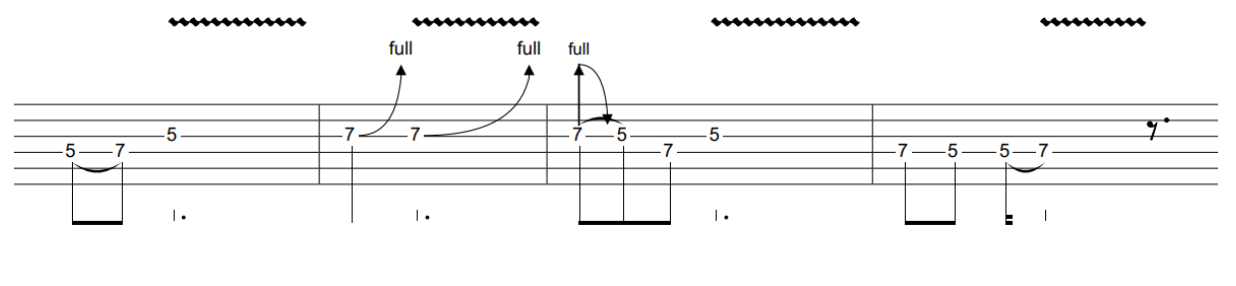
Here is a vibrato lick that appears in the attached video. You can use these principles and examples in your own playing to add a really vocal like characteristic to your playing. Don’t focus too much on getting your vibrato to sound exactly like your heroes, but learn from them and use elements of their vibrato in your own style and develop your own voice.